Share This Article
Upright Radiotherapy: Compact Vaults, Patient Positioning and What It Means for Department Design
Upright Radiotherapy: Compact Vaults, Patient Positioning and What It Means for Department Design
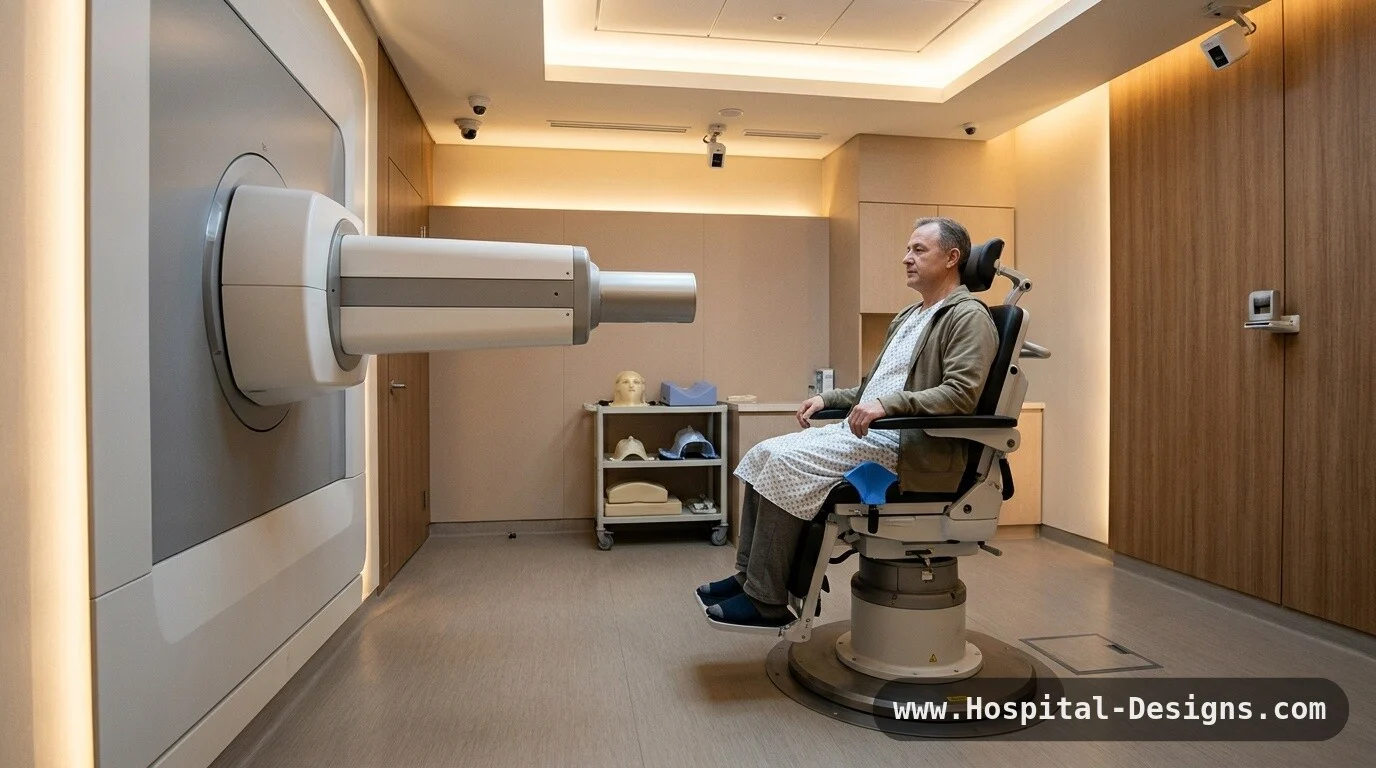
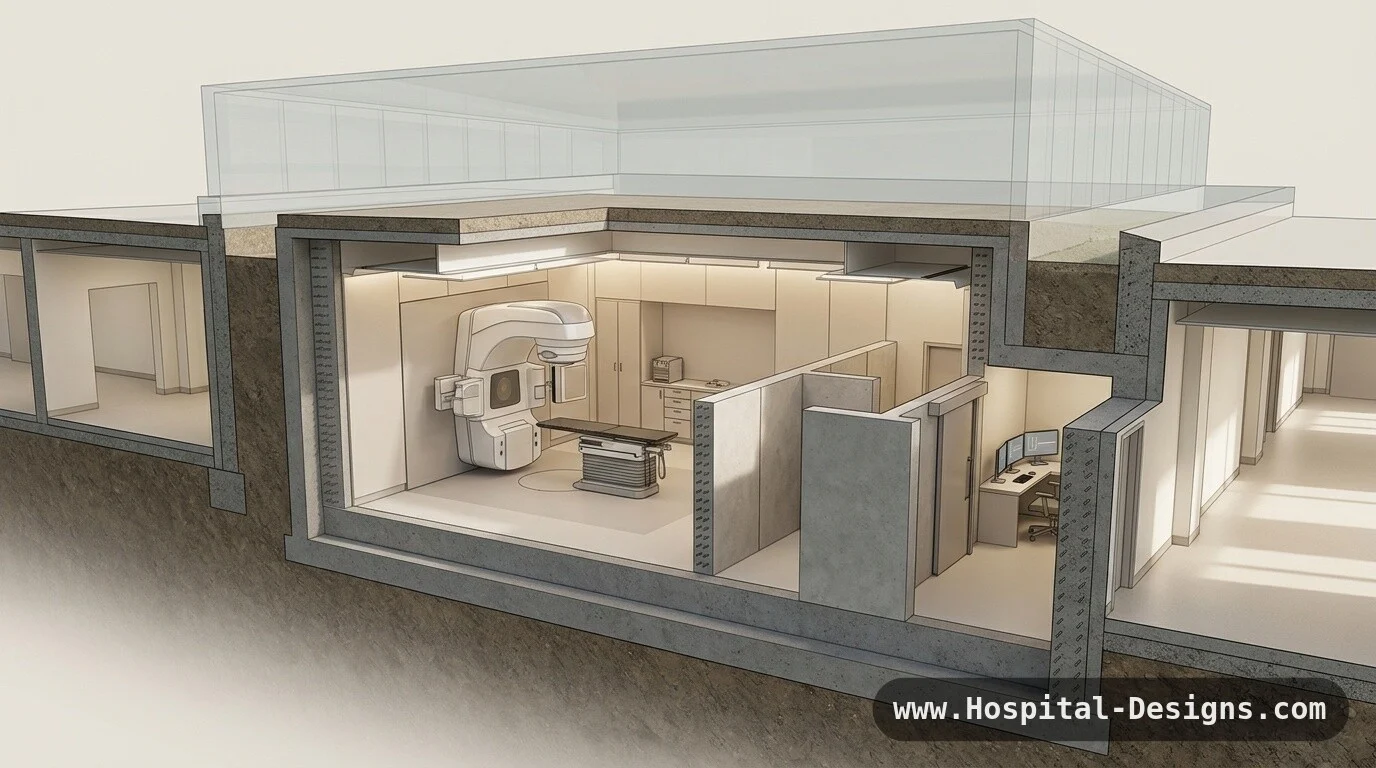
Conventional radiotherapy rotates a heavy gantry around a patient lying down. Upright systems turn the geometry around: the beam stays fixed and the patient rotates. Vendors argue that this can shrink the equipment footprint, ease positioning for some patients and lower the barrier to building a treatment room. For the hospital designer, the questions are practical: does the vault get smaller, does shielding change, and how do patients move through the department?
Planning principle: a new geometry changes the shielding assessment. It does not remove it.
1. How the Geometry Changes the Room
| Topic | Conventional gantry linac | Upright system | Design implication |
|---|---|---|---|
| Beam direction | Rotates through 360 degrees, so most walls, floor and ceiling can be primary barriers. | Fixed beam direction, so the primary barrier is concentrated in a defined area. | The shielding can be targeted, but the physicist must confirm the fixed-beam assumptions for the exact system. |
| Room size | Large vault to clear the rotating gantry and couch. | Potentially smaller, since no large gantry rotation is needed. | Use the manufacturer’s site guide, not assumptions, for dimensions. |
| Patient position | Supine or prone on a couch. | Seated or standing on a rotating chair. | Positioning, immobilisation and imaging workflows change. |
| Imaging | On-board cone-beam or CT imaging on the gantry. | Upright imaging, which may use CT or other methods depending on the system. | Plan the imaging room and workflow with the clinical team. |
2. Shielding Implications
- Primary barrier: with a fixed beam, the primary barrier faces one direction. The physicist assesses it with the real workload and use factor for that geometry.
- Secondary barriers: scatter and leakage still need assessment on every side.
- Neutrons: if the energy is high enough to produce neutrons, the maze and door need assessment. Proton systems have additional shielding and activation considerations.
- Ceiling, floor and adjacent rooms: assess occupancy above and below, since these can change when the beam direction is fixed.
For the method behind these checks, see our guide to linear accelerator bunker design.
3. Patient Experience and Workflow
- Accessibility: some patients find sitting easier than lying flat, for example those with breathing difficulty or pain. Others will need help to get on and off the chair. Plan transfer space and handrails.
- Immobilisation: upright immobilisation devices need storage and a preparation area near the room.
- Changing and waiting: unchanged in principle, but include space for patients who arrive on trolleys or in wheelchairs.
- Staff ergonomics: positioning an upright patient differs from lifting a supine one, so involve therapists in the layout.
4. Services, Safety and Resilience
- Power, cooling and data per the manufacturer, with resilience for treatment-critical systems. See our essential power design guide.
- Door interlocks, search procedures, cameras and intercom, as in any treatment room.
- A plan for emergency access to a patient who is seated or standing, and for fainting or falls.
5. Questions to Ask Before Committing
- Is the system cleared in your market, and for which treatment sites?
- What clinical evidence exists, and is it enough for your referral pathways?
- What are the site guide dimensions, shielding assumptions and installation route?
- How does the system integrate with your planning, record and verify systems?
- What is the upgrade and service plan?
6. Common Mistakes
- Assuming a smaller machine always means a much smaller vault.
- Reusing a conventional shielding calculation for a fixed-beam geometry.
- Forgetting transfer space and support for frail patients.
- Planning one room without the imaging, planning and QA workflow around it.
7. Review Checklist
- Product status, indications and evidence confirmed?
- Shielding reassessed by the RPA or qualified expert for the exact geometry?
- Dimensions, delivery route and services confirmed with the manufacturer?
- Patient transfer, immobilisation storage and emergency access designed?
- Staff involved in layout and ergonomics?
Conclusion
Upright radiotherapy is an interesting attempt to make treatment rooms smaller and more accessible. Until the evidence and installed base mature, plan it as an emerging technology: confirm status, reassess the physics, and design the patient flow around a different way of positioning people.
Key References and Further Reading
- Physics World — Leo Cancer Care launches first upright photon therapy system.
- UK HSE — Ionising radiation guidance and IRR 2017.
- NCRP — Report No. 151.
Editorial note: This article is an independent design overview. Product information comes from public announcements and may change. Shielding must be designed and verified by a qualified radiation protection expert.
We would like to hear your ideas on the design process and any stories you would like to share about how your workplace is influenced by the same via the Contact form.
About the Author:
Harry McQue is a hospital Design & Equipment Manager with Post Graduate degrees in business management and information technology. Harry has 20+ years of international experience ranging from working on hospital projects in Dubai (Middle East) to over £1 billion hospital projects in the UK & Europe. You can benefit from his experience at: hospital-designs.com. If you have current or upcoming projects, big or small or topics that you would like his advice on, you can get in touch via the Contact form.
Use permitted only with prior authorisation. Please contact for permission or guidance.