Share This Article
Siemens Healthineers Accela Linac: Speed Claims, AI Workflow and Regulatory Status
Siemens Healthineers Accela Linac: Speed Claims, AI Workflow and Regulatory Status
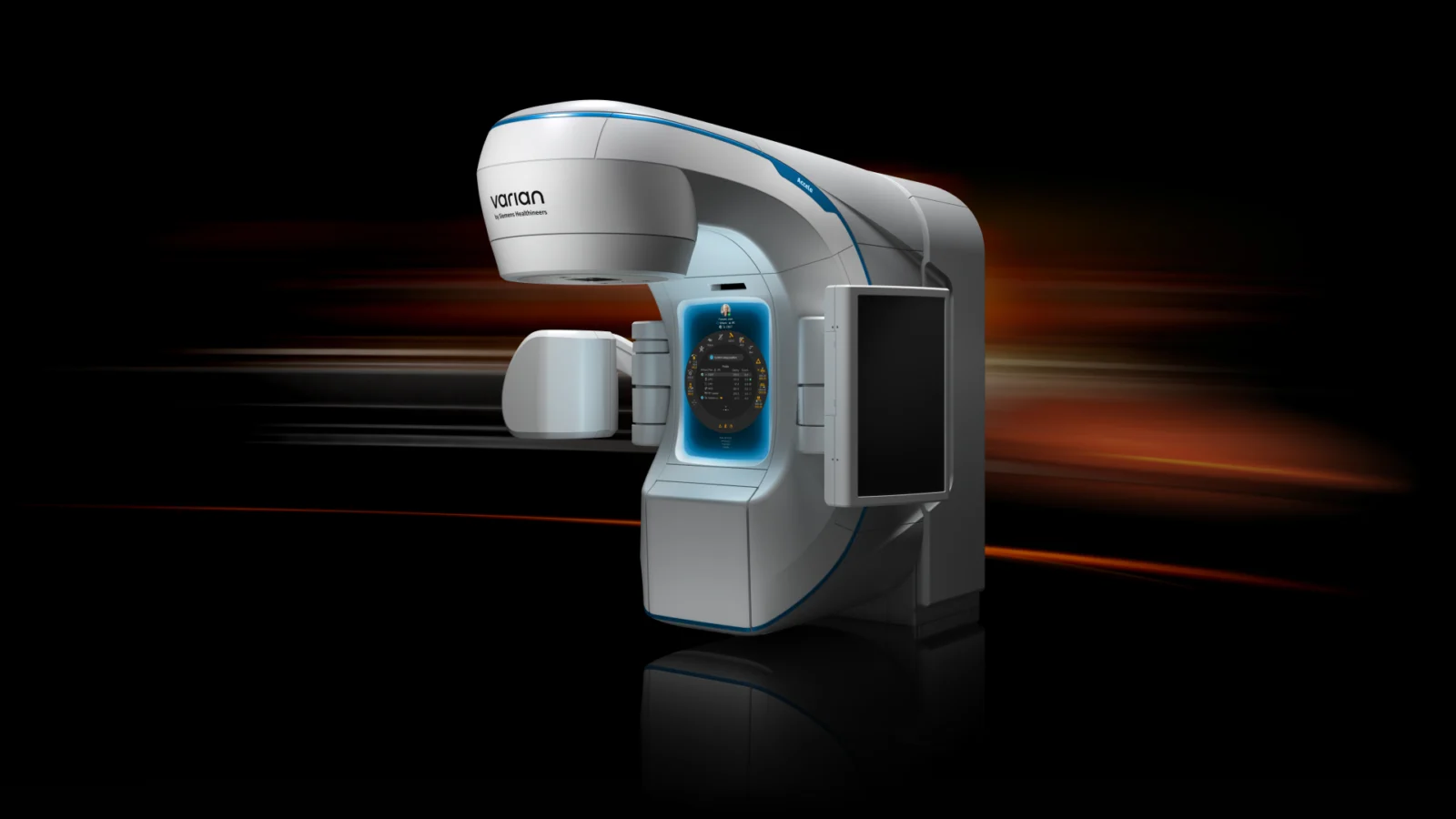
Linear accelerators are the workhorses of radiotherapy, and Accela is Siemens Healthineers’ newest linac, developed with Varian. Siemens positions it around speed and automation: fast imaging, AI-assisted planning and adaptive treatment on one platform. For planners searching medical linear accelerator, linac for radiotherapy, adaptive radiotherapy or CBCT image-guided radiotherapy, here is what has actually been published.
1. Published Specifications and Claims
| Area | Published detail |
|---|---|
| Speed (manufacturer claims) | |
| Single breath-hold CBCT | As low as 15 seconds |
| Imaging to beam-off | As low as 90 seconds |
| Imaging to treatment | Under a minute |
| Multi-site SBRT delivery | As low as one minute |
| Hardware | |
| MLC | Dual-layer MLC (leaf count and width not published) |
| Gantry | High-speed gantry (speed not published) |
| Imaging | HyperSight imaging panel, described as Siemens’ largest (dimensions not published) |
| Dose rate | “High dose rates” (values not published) |
| Energies, couch, vault dimensions, weight, power | Not published. Request the datasheet. |
| Software and automation | |
| Planning | Eclipse Neo: automation from contouring to plan generation |
| Adaptive therapy | Online (on-couch) and offline workflows using HyperSight and AI |
| Backup Planner | Plan conversion across machines, techniques and energies |
| SiteSync | Remote visualisation of the treatment console; beam-on and axis motion cannot be operated remotely |
Source: Siemens Healthineers — Accela.
2. Regulatory Status
| Market | Status on the product page |
|---|---|
| EU | CE marked |
| UK | Not stated; confirm UKCA or recognised CE route and MHRA registration |
| US | 510(k) pending; not available for sale in the US |
3. How to Compare Accela With Other Linacs
Use this side-by-side grid when you request datasheets from Siemens Healthineers, Varian, Elekta and others. Fill every cell from the vendor’s official specification, not from marketing pages.
| Criterion | Accela | Vendor B | Vendor C |
|---|---|---|---|
| Photon energies and FFF modes | Request | ||
| Maximum dose rate | Request | ||
| MLC type and leaf width | Dual-layer | ||
| Imaging (CBCT time, field of view) | 15 s breath-hold CBCT claim | ||
| Adaptive workflow | Online and offline | ||
| Planning automation | Eclipse Neo | ||
| Vault size and shielding | Request | ||
| Regulatory (UK, EU, US) | CE; US pending | ||
| Uptime guarantee and service | Request |
4. Procurement Checklist
- Beam energies, flattening-filter-free modes and maximum dose rate.
- MLC design, leaf width, maximum field size and leakage.
- Image guidance options, CBCT quality and adaptive-workflow readiness.
- Vault shielding assumptions, floor loading and services (power, cooling, data).
- Oncology information system and planning-system compatibility.
- Service model, uptime guarantee, spare parts and software upgrade costs.
5. Related Equipment and Search Terms
Buyers researching a linac also look at radiotherapy treatment planning software, patient positioning and immobilisation equipment, linac QA and dosimetry phantoms, ionisation chambers, surface-guided radiotherapy systems, radiotherapy vault shielding doors, and oncology information systems.
Conclusion
Accela’s published story is speed and automation, supported by specific timing claims. Hardware numbers and the US clearance are still outstanding, so use the comparison grid, request datasheets and ask for independent timing data before treating it as equivalent to an established linac.
Sources, Brochures and Further Reading
Editorial note: Independent overview of public sources. Images are credited to their owners. Confirm all figures with the manufacturer. Not clinical, physics or regulatory advice.
We would like to hear your ideas on the design process and any stories you would like to share about how your workplace is influenced by the same via the Contact form.
About the Author:
Harry McQue is a hospital Design & Equipment Manager with Post Graduate degrees in business management and information technology. Harry has 20+ years of international experience ranging from working on hospital projects in Dubai (Middle East) to over £1 billion hospital projects in the UK & Europe. You can benefit from his experience at: hospital-designs.com. If you have current or upcoming projects, big or small or topics that you would like his advice on, you can get in touch via the Contact form.
Use permitted only with prior authorisation. Please contact for permission or guidance.