Share This Article
Helium-Free MRI: What Sealed Magnets Change for Siting, Quench Venting and Room Design
Helium-Free MRI: What Sealed Magnets Change for Siting, Quench Venting and Room Design
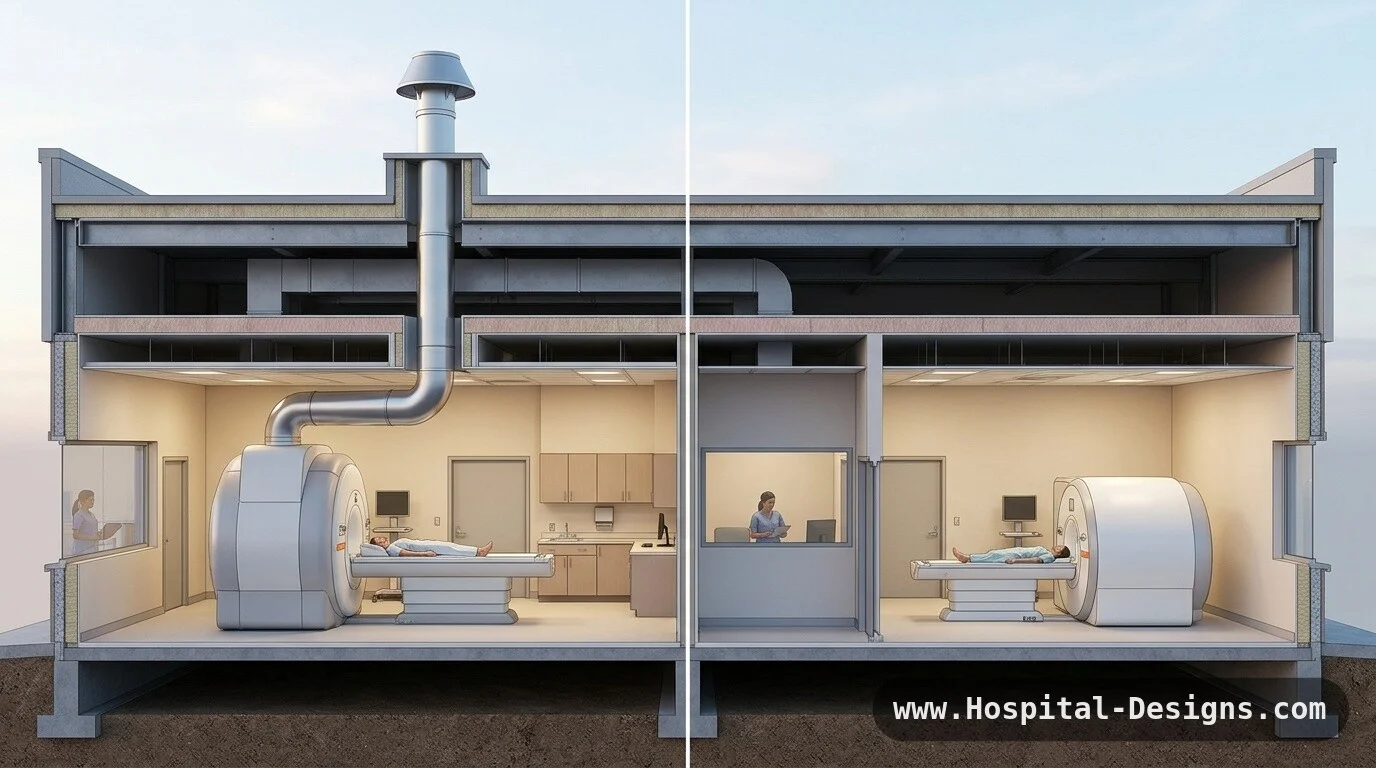
Conventional superconducting magnets rely on large volumes of liquid helium and a quench pipe to vent it safely. Newer magnets use much less helium, or seal it in. That can simplify some parts of the room, but it does not remove the need for safety zoning, RF shielding, fringe-field control or structural planning. This guide separates what changes from what stays the same.
Planning principle: a sealed magnet reduces one hazard and one construction item. It does not make the MRI room an ordinary room.
1. What Changes and What Does Not
| Topic | Conventional magnet | Sealed or low-helium magnet | Design implication |
|---|---|---|---|
| Quench vent | Dedicated vent pipe to outside, sized by the supplier. | Vent requirement depends on model; some designs need a much smaller route or none. Confirm with the manufacturer. | Do not delete the vent from the design until the supplier confirms in writing for that model and market. |
| Helium logistics | Delivery, refills and a service plan for cryogens. | Reduced or no refills, depending on design. | Simplified service access, but keep a service strategy. |
| Weight and size | Heavy, large magnet. | Often lighter or more compact, but varies by model. | Check floor loading and delivery route against the real specification. |
| RF shielding | Required. | Required. | No change: continuous shield, tested penetrations. |
| Magnetic safety | Four-zone model, access control, screening. | Same hazards for ferromagnetic objects and implants. | No change: zoning, screening and emergency procedures. |
| Fringe field | Plot per model. | Plot per model; may differ. | Obtain plots in three planes and check rooms above and below. |
2. Siting Opportunities
- Without a long vent route, MRI can sometimes be sited in places where a rooftop vent was impractical, such as inner or lower-floor locations. Confirm the supplier’s position on the model.
- Lighter and more compact systems may suit refurbishment or satellite diagnostic centres, subject to structure and delivery.
- Do not use the saved vent route as a reason to ignore magnetic interference from lifts, vehicles and plant. A site survey is still needed.
3. What Stays the Same
- Safety zoning and access control: see our MRI suite design guide.
- RF shielding: continuous enclosure, with waveguides and filters on every penetration, tested after installation.
- Cooling and power: chillers, gradient cooling and electrical supply per the site planning guide, with a resilience plan. See our essential power design guide.
- Acoustics and vibration: gradient noise still needs treatment, and vibration criteria still apply.
- Emergency planning: staff training, resuscitation outside Zone IV, and fire and rescue briefing.
4. Procurement and Risk Questions
- Is the model CE/UKCA marked, FDA-cleared, or still pending in your market?
- What does the manufacturer state in writing about quench behaviour and venting for this model?
- What are the magnet field strength, bore and weight, and how do they compare with the existing room?
- What is the service model and the end-of-life plan for the magnet?
- Does the existing RF shield, door and window suit the new system?
5. Common Mistakes
- Deleting the quench vent from the design on the strength of marketing material.
- Assuming no cryogen means no safety zoning.
- Skipping the magnetic interference survey because the magnet is compact.
- Re-using an old RF shield without testing.
- Not checking the fringe field in the vertical section.
6. Review Checklist
- Written supplier confirmation of vent and quench requirements for the exact model?
- Floor loading, delivery route and replacement route checked?
- Fringe-field plots obtained and reviewed in plan and section?
- RF shield and penetrations designed and tested?
- Zoning, access control and MR safety roles confirmed?
- Cooling, power and resilience agreed?
Conclusion
Sealed and low-helium magnets are a genuine step for siting and sustainability, but the MRI room is still a magnetic, RF and safety environment. Use the new technology to simplify the parts that the supplier confirms can be simplified, and keep every other safeguard.
Key References and Further Reading
- Siemens Healthineers — RSNA: MAGNETOM Flow platform.
- MedCity News — Philips imaging announcements at RSNA 2025.
- AuntMinnie — GE HealthCare features new MRI scanners.
- MHRA — Safety guidelines for MRI equipment in clinical use.
Editorial note: This article is an independent design overview. Product information comes from public announcements and may change. It does not replace the manufacturer’s site planning guide, current standards, or the advice of an MR safety expert and qualified engineers.
We would like to hear your ideas on the design process and any stories you would like to share about how your workplace is influenced by the same via the Contact form.
About the Author:
Harry McQue is a hospital Design & Equipment Manager with Post Graduate degrees in business management and information technology. Harry has 20+ years of international experience ranging from working on hospital projects in Dubai (Middle East) to over £1 billion hospital projects in the UK & Europe. You can benefit from his experience at: hospital-designs.com. If you have current or upcoming projects, big or small or topics that you would like his advice on, you can get in touch via the Contact form.
Use permitted only with prior authorisation. Please contact for permission or guidance.