Share This Article
CSSD Design Guide: UK HTM 01-01 vs US AAMI ST79 Standards
CSSD Design Guide: UK HTM 01-01 vs US AAMI ST79 Standards
A Central Sterile Services Department (CSSD)—also known as a sterile services department or sterile processing department (SPD)—is one of the hospital’s most important support facilities. Its performance affects operating theatre capacity, infection prevention, instrument availability, staff safety and the continuity of clinical services. Yet CSSD planning is often treated as an equipment-layout exercise rather than the design of a controlled, one-way decontamination process.
A successful CSSD design begins with the movement of contaminated devices and ends with the controlled release and distribution of sterile, ready-to-use sets. The building must support separation between dirty and clean activities, validated reprocessing, safe handling, traceability, environmental control, equipment maintenance and future demand. This guide compares the UK HTM 01-01 framework with the US AAMI ST79 approach, and translates the standards discussion into practical architectural, engineering and operational decisions.
Planning principle: the department should make the correct workflow the easiest workflow. Staff should not need to cross clean and dirty routes, pass instruments back through a contaminated zone, or improvise storage because the building has not provided enough capacity.
1. What a CSSD Must Achieve
CSSD is a linked sequence of controlled processes, not simply a collection of washers and sterilizers. The department receives used reusable medical devices, safely contains and transports them, cleans and decontaminates them, inspects and assembles them, packages them, processes them through an approved sterilization cycle where appropriate, releases them after the required checks, and stores and distributes them without compromising the achieved condition.
The design brief should be developed with sterile-services management, infection prevention and control, operating theatre representatives, medical-device users, estates, health and safety, procurement, equipment suppliers and the design team. Confirm the service model before fixing the room schedule: an on-site department, a shared hub, and a contracted off-site service have different transport, resilience, storage and turnaround implications.
- Patient safety: support reliable cleaning, disinfection where required, inspection, packaging, sterilization and release.
- Staff safety: reduce exposure to contaminated devices, sharps, chemicals, heat, steam and manual-handling risks.
- Workflow integrity: establish clear dirty-to-clean progression and prevent inappropriate cross-traffic.
- Traceability: provide space and infrastructure for identification, recording, quarantine and release controls.
- Operational continuity: plan for equipment downtime, maintenance, utilities interruption and peak demand.
- Adaptability: allow for changes in instrument volumes, device complexity, equipment dimensions and digital systems.
2. UK HTM 01-01 and US AAMI ST79: How to Compare Them
These documents should not be presented as legally identical or as direct one-for-one equivalents. HTM 01-01 is NHS healthcare technical guidance for the decontamination of surgical instruments in the UK context. AAMI ST79 is a US consensus standard addressing comprehensive steam sterilization and sterility assurance in healthcare facilities. Their scope, structure, regulatory setting and adoption mechanisms differ.
| Design topic | UK: HTM 01-01 framework | US: AAMI ST79 framework | Design implication |
|---|---|---|---|
| Governance and service model | Management responsibilities, provision and operational arrangements form part of the guidance. | Establishes practices for a comprehensive steam sterilization and sterility assurance programme. | Agree accountability, service scope, quality system and interfaces before room planning. |
| Facility layout | Design and installation guidance supports facilities suitable for the required decontamination processes. | Addresses facilities and environmental considerations for processing areas. | Develop an activity-based room data sheet and process adjacency plan, then validate against the applicable local requirements. |
| Process separation | Supports controlled separation of stages and prevention of recontamination. | Supports separation of decontamination, preparation/packaging and sterile storage activities. | Use physical zoning, controlled pass-throughs and managed personnel/material routes. |
| Equipment and utilities | Design and installation must accommodate the specified equipment and its service requirements. | Addresses sterilizer installation, utilities, operating conditions and related process controls. | Obtain supplier utility schedules early; verify steam, water, drainage, electrical, ventilation, heat rejection and access. |
| Validation and monitoring | Requires an appropriate technical and operational assurance approach under the relevant guidance. | Provides recommendations for monitoring and sterility assurance practices. | Design for testing, calibration, records, alarms, release checks and access to monitoring points. |
| Operational control | Includes operational management and performance expectations. | Addresses routine sterilization practices, quality assurance and documentation. | Ensure the completed facility can be operated and maintained safely—not merely commissioned once. |
For every project, check the current published documents and the edition or requirements formally adopted by the client, regulator, accreditation body and authority having jurisdiction. A US project may also be subject to state rules, federal requirements, facility accreditation conditions and other standards. A UK project must identify the applicable national guidance and local governance. The comparison above is a planning aid, not a compliance checklist.
3. The One-Way Workflow: Dirty to Clean to Sterile
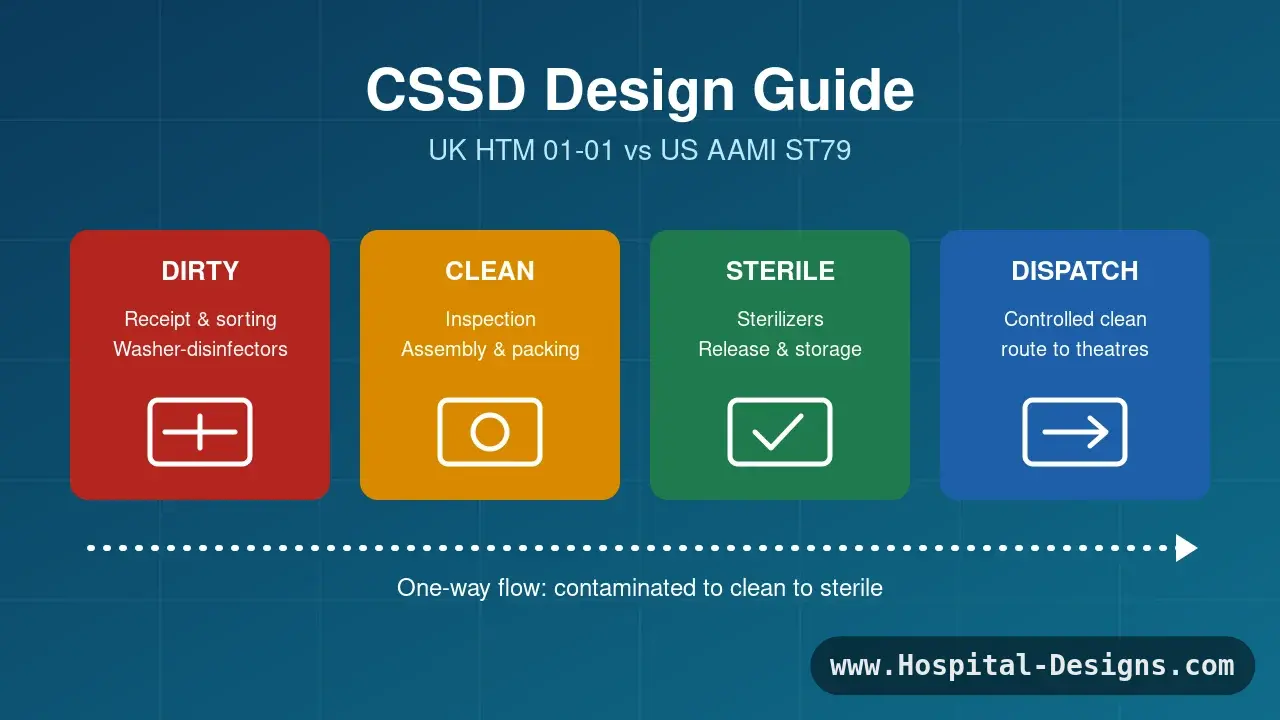
The most important planning move is to map the entire instrument journey before drawing the department. A typical sequence is: receipt and sorting of used devices; decontamination and washing; inspection, assembly and packaging; sterilization; release; sterile storage; and dispatch. The exact process depends on device instructions for use, validated reprocessing methods, equipment and the service model.
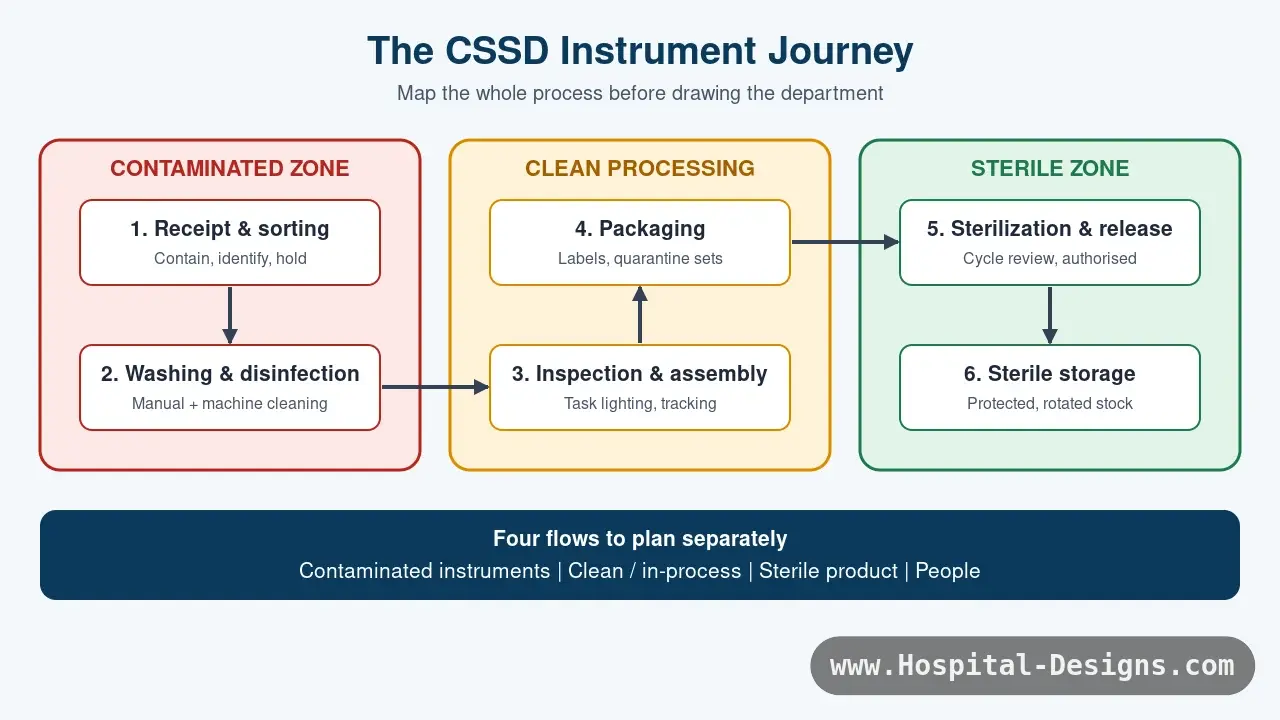
Separate the contaminated receiving and decontamination functions from clean inspection and preparation, and protect sterile storage from contamination and unnecessary traffic. A pass-through washer-disinfector or sterilizer may support the process boundary, but the equipment itself does not automatically create a compliant barrier. The surrounding walls, doors, transfer arrangements, controls, maintenance access and staff procedures must work together.
Dirty receiving and sorting
Provide a defined point for incoming containers and trolleys, with sufficient space to unload, identify, sort and contain used devices safely. Avoid making the receiving area a through-route to clean rooms. Plan for secure temporary holding, waste segregation, hand hygiene, personal protective equipment, sharps precautions and safe trolley manoeuvring. Dirty returns should not be parked in corridors or adjacent to clean dispatch.
Decontamination and washing
Room planning must accommodate sinks, manual cleaning tasks where permitted, ultrasonic equipment where specified, washer-disinfectors, loading and unloading zones, chemical storage and safe handling. Follow device manufacturers’ instructions and validated local procedures; not every device follows the same process. Ensure that equipment doors, racks and service panels can be operated without blocking circulation or creating unsafe lifting.
Inspection, assembly and packaging
This is a clean activity requiring suitable work surfaces, task lighting, magnification where needed, controlled storage of packaging materials and adequate space to assemble sets. Plan for instrument tracking terminals, label printers, count sheets or digital records, and segregated quarantine of damaged, incomplete or non-conforming sets. Do not allow inspected devices to be exposed to dirty returns or uncontrolled trolley movement.
Sterilization and release
Provide space for sterilizer loading and unloading, cooling where required by the process, review of cycle records, routine monitoring and authorised release. Separate rejected or quarantined loads from released product. The release process must be defined by the facility’s quality system and applicable standard; a machine cycle ending is not, by itself, permission to distribute every load.
Sterile storage and dispatch
Protect packaged sterile devices from moisture, dust, physical damage, excessive handling and unsuitable environmental conditions. Provide shelving and storage systems appropriate to the packaging and stock-control policy, clear identification, stock rotation and enough capacity for peak inventory. Dispatch should be a controlled clean route to operating theatres, clinics or the agreed logistics interface.
4. Room Schedule and Adjacency Planning
There is no universally correct room list or floor area for every CSSD. Size the department from the instrument workload, number and type of operating theatres, case mix, peak operating schedule, turnaround targets, reprocessing methods, equipment throughput, staffing model, storage policy and resilience requirements.
| Functional zone | Typical spaces and provisions | Key planning checks |
|---|---|---|
| Contaminated | Receipt, sorting, dirty holding, decontamination, wash equipment, waste and PPE support | Contained returns, cleanable finishes, safe handling, suitable exhaust/ventilation strategy and controlled access. |
| Clean processing | Inspection, assembly, set preparation, packaging and clean equipment staging | Task lighting, workbench ergonomics, clean storage, adequate workstations and protected workflow. |
| Sterilization | Sterilizer loading/unloading, process monitoring, cooling and quarantine/release areas | Supplier clearances, heat management, safe access, utility isolation and maintenance strategy. |
| Sterile storage | Released stock storage, picking, dispatch and returns management | Protected storage, inventory visibility, stock rotation, security and clean dispatch route. |
| Staff and support | Changing, lockers, offices, staff welfare, training, records and plant/service spaces | Staff routes, hand hygiene, supervision, equipment access and separation from product routes. |
Adjacency diagrams should show at least four flows independently: contaminated instruments, clean/in-process instruments, sterile product, and people. Add waste, consumables, maintenance and emergency routes. Where routes must intersect, document how the risk is controlled rather than assuming that a line on a drawing is sufficient.
5. Building Services: HVAC, Water, Steam, Drainage and Power
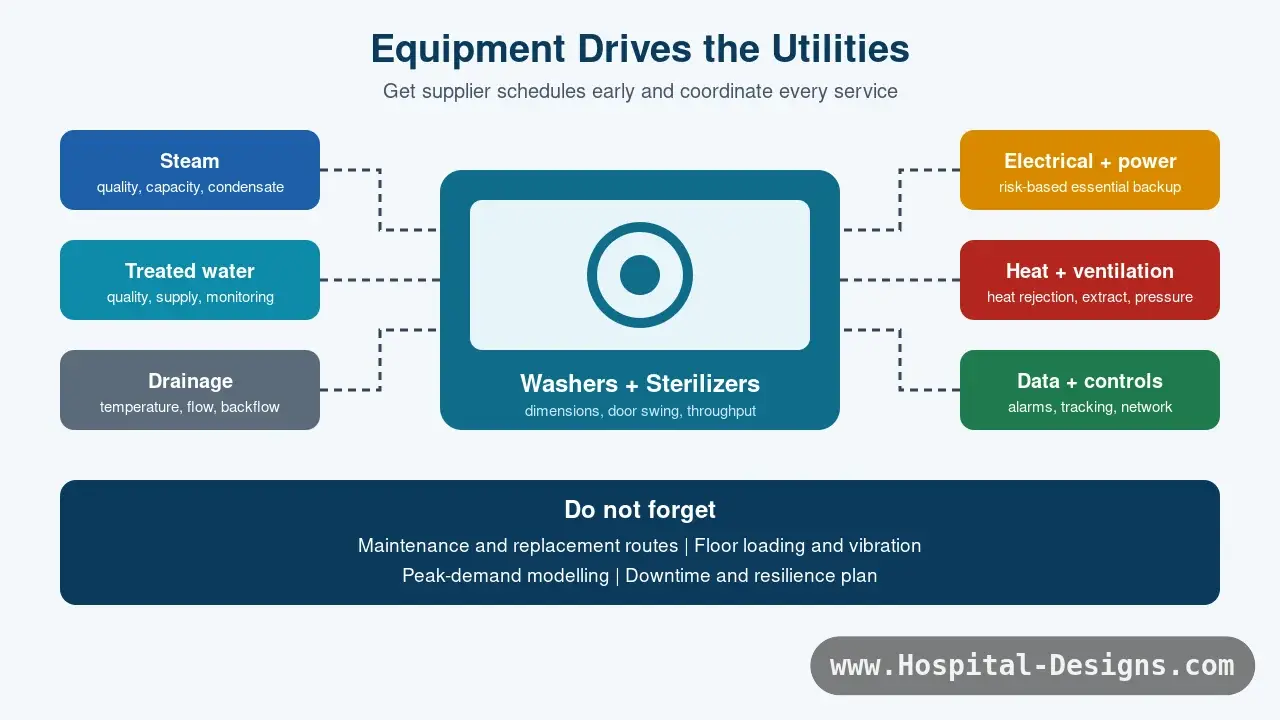
CSSD equipment has demanding and sometimes highly variable utility requirements. The architect and MEP team should obtain current technical submittals for the selected equipment and coordinate them with the process design, infection prevention strategy, commissioning plan and facilities maintenance team.
Ventilation and environmental control
Do not apply a generic air-change figure to every CSSD room. Establish the required environmental conditions and pressure relationships from the applicable healthcare guidance, risk assessment, process requirements and equipment manufacturers. The design should address heat and moisture from washers and sterilizers, chemical or contaminant extraction where needed, room-to-room airflow direction, filtration, comfort, access for filter maintenance and monitoring. Verify actual airflow and pressure performance during commissioning and under representative operating conditions.
Water quality and supply
Water quality can directly affect cleaning performance, device condition, equipment reliability and final rinse outcomes. Define water treatment and quality requirements with the equipment suppliers and decontamination lead. Consider incoming water characteristics, softening, reverse osmosis or other treatment where specified, storage and distribution, sampling points, monitoring, alarms, maintenance and failure response. Do not assume one water specification is suitable for every stage or every machine.
Steam systems
Where steam sterilizers are used, confirm the required steam quality, capacity, pressure, dryness and other parameters with the sterilizer manufacturer and applicable standards. Coordinate plant capacity, distribution, condensate management, isolation, safe discharge, pipework materials, insulation and access. A steam supply that is nominally available but unstable under simultaneous peak demand can undermine throughput and process reliability.
Drainage and waste
Coordinate machine discharge temperatures and flow rates, trapped connections, backflow protection where required, floor drainage strategy, chemical compatibility and maintenance access. Confirm whether local rules or equipment instructions require cooling or other treatment before discharge. Avoid floor gullies or drainage details that create splash, odour or cleaning problems in clean areas.
Electrical, controls and data
Provide supplies and protective arrangements to the equipment manufacturer’s requirements and applicable electrical codes. Consider essential-power strategy where justified by the clinical risk and operational continuity assessment; do not assume every machine needs the same backup arrangement. Allow for equipment control panels, building management interfaces where appropriate, alarms, network connectivity, instrument tracking, label printing, cybersecurity and future system upgrades.
6. Equipment Planning and Capacity Modelling
Equipment selection should follow a process and capacity study—not the other way around. Build a workload model using actual or forecast case volumes, instrument set composition, peak operating lists, turnaround expectations, rewash rates, maintenance downtime, shift patterns and planned growth. Model the bottleneck at each stage: receipt, washer loading, inspection benches, packaging, sterilizer cycles, cooling, release and storage.
For each major item, obtain and coordinate:
- Overall dimensions, operating envelope, door swing and loading/unloading clearances.
- Throughput assumptions, cycle times, rack capacity and utility demand.
- Heat rejection, ventilation and drainage requirements.
- Maintenance access, component replacement route and service clearances.
- Noise, vibration, floor loading and any structural requirements.
- Controls, data interfaces, alarms, validation and commissioning requirements.
Do not size the department using average daily workload alone. Peak theatre activity, emergency demand, late returns, equipment downtime and delayed dispatch can create queues that quickly overwhelm an undersized department. Conversely, excessive installed capacity without a staffing and operating model can increase capital and lifecycle cost without improving service.
7. Staff Safety, Ergonomics and Human Factors
CSSD staff work with heavy instrument trays, hot loads, wet floors, chemicals, sharp devices and repetitive inspection tasks. Good design reduces risk through layout, equipment choice and workflow—not by relying solely on training or personal protective equipment.
- Keep trolley routes direct, level where possible, and wide enough for the actual equipment and turning movements.
- Set work surfaces and storage heights to reduce repetitive bending, reaching and lifting.
- Provide suitable task lighting and visual inspection conditions at assembly stations.
- Locate handwashing, PPE, eyewash or emergency provisions according to the risk assessment and applicable requirements.
- Separate staff changing and welfare facilities from instrument processing and storage.
- Provide safe access for maintenance and filter, chemical or consumable replacement.
- Design for cleaning: minimise inaccessible ledges, damaged joints and difficult-to-clean interfaces.
8. Digital Traceability and Quality Management
Modern sterile services increasingly depend on digital tracking to connect instruments and sets with cleaning, inspection, packaging, sterilization, release, storage and dispatch records. The physical design should support this workflow from the beginning.
Allow for terminals or scanners at the points where staff record each process stage, label printers, secure network coverage, equipment data interfaces, charging points and suitable screen positions. Consider how the system will handle quarantine, missing instruments, repairs, failed cycles, recalls, load release and audit trails. Plan a resilient manual contingency process for network or system outages, with controlled reconciliation when service is restored.
9. Commissioning, Validation and Handover
CSSD commissioning is a multidisciplinary process. It should include building services testing, equipment installation and qualification, process validation, environmental verification, training, documentation and operational readiness. Define the responsibilities of the client, design team, equipment supplier, commissioning specialists and department management in the project plan.
Key handover deliverables should include:
- Approved room data sheets, equipment schedules and coordinated as-built drawings.
- Utility test results, water-quality evidence and relevant ventilation/pressure test records.
- Equipment installation, operational and performance qualification documentation as applicable.
- Validated process documentation, monitoring arrangements and release procedures.
- Maintenance schedules, spare-parts strategy, warranties and service contacts.
- Staff training records, standard operating procedures and emergency/failure response plans.
- Digital traceability configuration, access permissions, backup and downtime procedures.
Plan for a period of operational proving with representative workloads before full service acceptance. A technically complete room is not necessarily an operationally ready CSSD.
10. Common CSSD Design Mistakes
- Designing around equipment before workflow: start with the process map, service model and capacity model, then select equipment and room dimensions.
- Relying on colour-coded floors alone: signage and floor markings cannot replace appropriate physical separation, controlled access and validated procedures.
- Undersizing sterile storage: insufficient storage creates congestion, excessive handling and pressure to use unsuitable overflow areas.
- Ignoring maintenance routes: large machines may be impossible to remove or service after walls, doors and ceilings are completed.
- Using generic HVAC or water assumptions: specify conditions from the process, applicable standards and supplier requirements.
- Failing to plan for downtime: define alternative capacity, equipment redundancy, service support and safe backlog management.
- Leaving digital systems until late: tracking, scanning, data and power requirements affect benches, routes and operational flow.
- Confusing a completed cycle with load release: provide a controlled review, quarantine and release process.
11. Practical CSSD Design Review Checklist
- Has the service model and instrument workload been agreed with clinical and operational stakeholders?
- Are dirty, clean processing, sterilization and sterile storage activities clearly defined and appropriately separated?
- Have contaminated, clean, sterile, staff, waste and maintenance flows been mapped independently?
- Are room sizes based on peak throughput, equipment clearances and safe staff movement?
- Have equipment suppliers confirmed water, steam, drainage, ventilation, electrical and data requirements?
- Are environmental conditions and pressure relationships based on the applicable guidance and risk assessment?
- Are inspection, packaging, quarantine, release and storage functions adequately accommodated?
- Can every major item be installed, maintained and replaced without damaging the building?
- Are traceability, alarms, downtime and recall procedures supported by the physical and digital infrastructure?
- Is there a documented commissioning, validation, training and operational-readiness plan?
12. Conclusion: Design the Process, Not Just the Department
A high-performing CSSD is the result of coordinated healthcare planning, architecture, engineering, equipment selection and operational governance. HTM 01-01 and AAMI ST79 provide important reference frameworks in their respective contexts, but neither should be reduced to a room checklist or copied across jurisdictions without checking local adoption and project requirements.
For designers, the most reliable starting point is a validated process map supported by workload modelling, room data sheets, equipment utility schedules and a clear separation strategy. When dirty returns, clean preparation, sterilization, release and sterile dispatch are designed as one connected system, the department is better placed to protect patients, support staff and sustain clinical services.
Key References and Further Reading
- NHS England — HTM 01-01: Decontamination of surgical instruments.
- AAMI — Standards programme and standards catalogue (consult the current adopted edition of ST79).
- US CDC — Disinfection and Sterilization guidance.
Editorial note: This article is a design and planning overview. It does not replace the current full standards, device manufacturers’ instructions for use, local regulatory requirements, or specialist validation and infection-prevention advice.
We would like to hear your ideas on the design process and any stories you would like to share about how your workplace is influenced by the same via the Contact form.
About the Author:
Harry McQue is a hospital Design & Equipment Manager with Post Graduate degrees in business management and information technology. Harry has 20+ years of international experience ranging from working on hospital projects in Dubai (Middle East) to over £1 billion hospital projects in the UK & Europe. You can benefit from his experience at: hospital-designs.com. If you have current or upcoming projects, big or small or topics that you would like his advice on, you can get in touch via the Contact form.
Use permitted only with prior authorisation. Please contact for permission or guidance.